Science
Providing academic expertise are the Institute of Biological, Environmental, and Rural Sciences IBERS at Aberystwyth University and the James Hutton Institute.

NUE-Leg will provide a unique network, scientific innovation, and the new knowledge needed by farmers and commercial partners to effectively utilise new legumes and associated technologies to deliver sustainable livestock systems and help farm businesses achieve net zero production.
Global human population forecasts of 10 billion by 2050 will raise food demand by 70% against a requirement for lower environmental impacts.
England’s livestock agriculture is tasked with increasing efficiency of production while reducing environmental impacts. Thus, GHG emissions must contract by 78% (by 2035), with a livestock industry seeking net-zero (2050) against a background of escalating energy/input costs. Ruminants only capture around 25% of nitrogen ingested from grasslands and create 45% of UK methane emissions through rumen digestion, manure and slurry.
To reduce GHG/nutrient loading, more herbage protein must convert into meat and milk. NUE-Leg will directly address this challenge by developing technological solutions to reduce environmental impacts while enhancing the economics and sustainability of grassland farming.
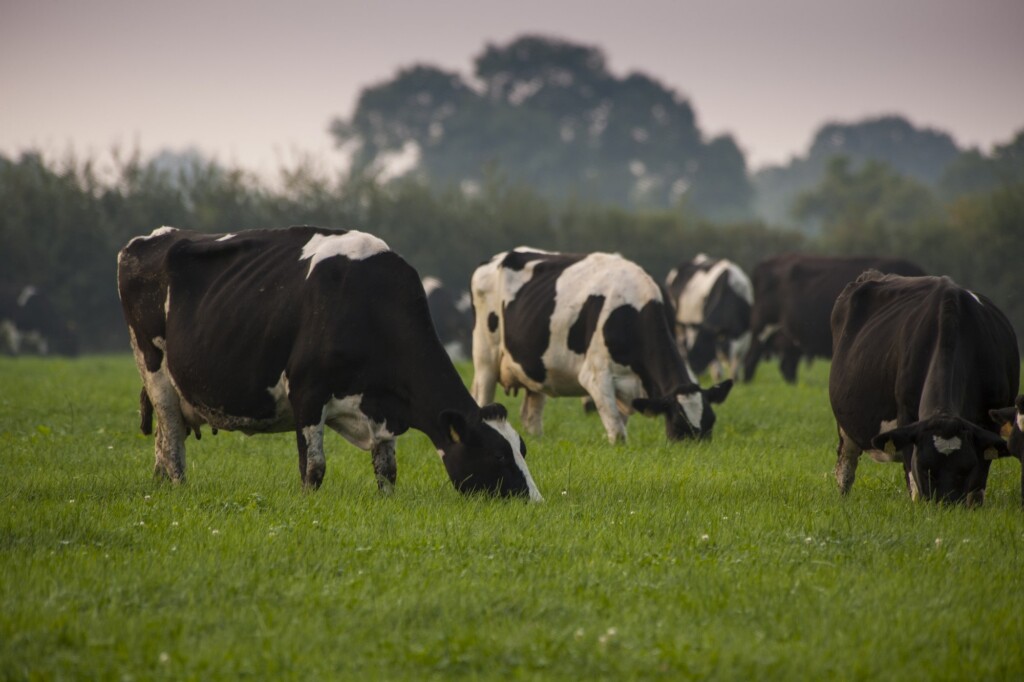
UK ruminant production relies predominantly on nitrogen fertiliser-driven perennial ryegrass, sometimes with white clover. Increased energy and nitrogen costs highlight the value of forage legume N-fixation which, with enhanced production efficiency and consistency, could lower a ruminant’s environmental impact.
The industry is over-reliant on applied N, largely ignoring the production benefits of proper soil nutrient balances and the specific micronutrient requirements for legume-rhizobium symbiosis. Transformation of the UK ruminant sector to systems that beneficially exploit forage legumes requires a paradigm shift in forage legume breeding and management. NUE-Leg delivers on this challenge by enhancing key genetic traits tailored to exploit precision crop management strategies that together deliver higher more consistent sward productivity.
A novel alliance between legume breeders, soil scientists, NGO/charity and industry across supply chains will provide farmers with the tools and resources to exploit these legume/nutrient benefits for productivity, farm economics and environmental improvement.
Academic and industry partners will work with livestock farmers using participatory research to quantify the on-farm impact of innovative varieties of three forage legume species, supported by elite rhizobia strains and state-of-the-art prescription nutrient fertilisers for optimal N-fixation. The benefits for livestock production will be evaluated and mitigation potential for environmental protection analysis using life-cycle-assessment.
On-farm trials conducted by supply chain partners/LEAF will test and develop technology in practice and widely demonstrate the achievable benefits to grassland farmers across the beef, sheep and dairy sectors.
NUE-Leg will deliver blueprints for exploiting novel, elite legume varieties and identify traits for continued breeding improvement, determine farm-specific prescription nutrient need and provide digital knowledge exchange (KE) systems to guide farmers. This integrated optimisation approach will greatly enhance grassland farming in mitigating enteric methane emissions, lowering nitrate losses, while boosting ruminant productivity and sustainable farm businesses.
Project Partners
Project NUE-Leg has brought together the leading agricultural minds from science, industrial research, food production, and other sectors.

Get in touch